Introduction: A Misdiagnosed Problem
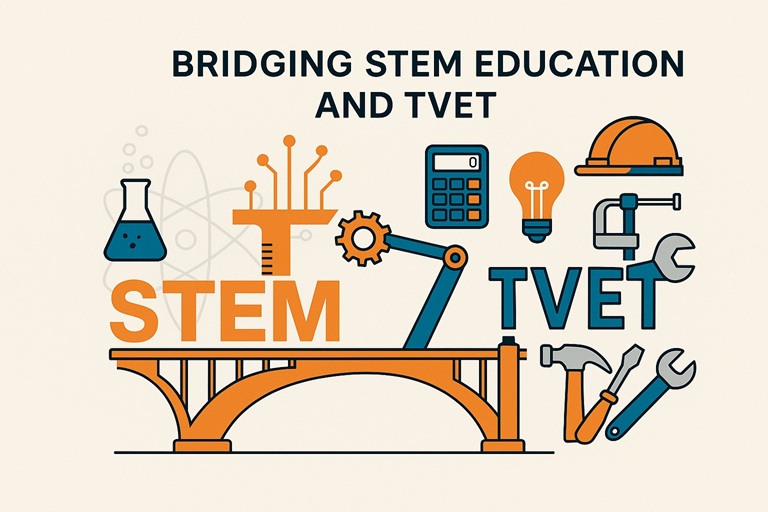
A common narrative suggests that Africa lacks creativity. This is misleading. The real issue is not a lack of talent, but a systemic disconnect between STEM education and Technical and Vocational Education and Training (TVET).
STEM provides theory and analytical thinking, while TVET emphasizes practical skills. When separated, both become incomplete. When combined, they generate innovation and entrepreneurship.
The Problem of Parallel Tracks
Many students excel at solving equations but struggle to apply them in real-world contexts. Meanwhile, TVET learners develop hands-on skills but often lack the scientific foundation to innovate beyond routine tasks.
This separation limits creativity. It produces individuals who can either think without building, or build without evolving.
Newton’s Second Law as a Case Study
F = m·a
- STEM-only: An equation solved in exams
- TVET-only: Mechanical work without understanding
- Integrated: Real engineering solutions designed and tested
Creativity emerges when theory meets practice.
Lessons from Ghana
Ghana’s experience highlights a key paradox: some TVET institutions have better equipment than local industries. Students train on advanced systems but enter workplaces that cannot utilize their skills.
This mismatch prevents innovation from translating into real economic impact.
Why the Creativity Myth Persists
- Over-theorization in education
- Stigma against vocational training
- Weak industrial infrastructure
- Policy fragmentation
Reclaiming Creativity: A Five-Point Agenda
1. Curriculum Redesign
Integrate practical projects into STEM and scientific principles into TVET.
2. Industry–School Partnerships
Align training with real-world industry needs.
3. Innovation Hubs
Create spaces for experimentation, prototyping, and entrepreneurship.
4. Changing Perceptions
Promote TVET as a first-choice pathway for innovation.
5. Policy Integration
Coordinate reforms across education, trade, and industry.
Broader Impacts
- A more creative and job-ready workforce
- Increased industrial innovation
- Reduced stigma around TVET
- Improved global competitiveness
Conclusion: Creativity Through Connection
Creativity is not an inherent trait of a region—it is the result of systems that connect knowledge to application.
Africa’s challenge is not a lack of brains, but a lack of bridges.
Build the bridge, and creativity will flow.