Overview
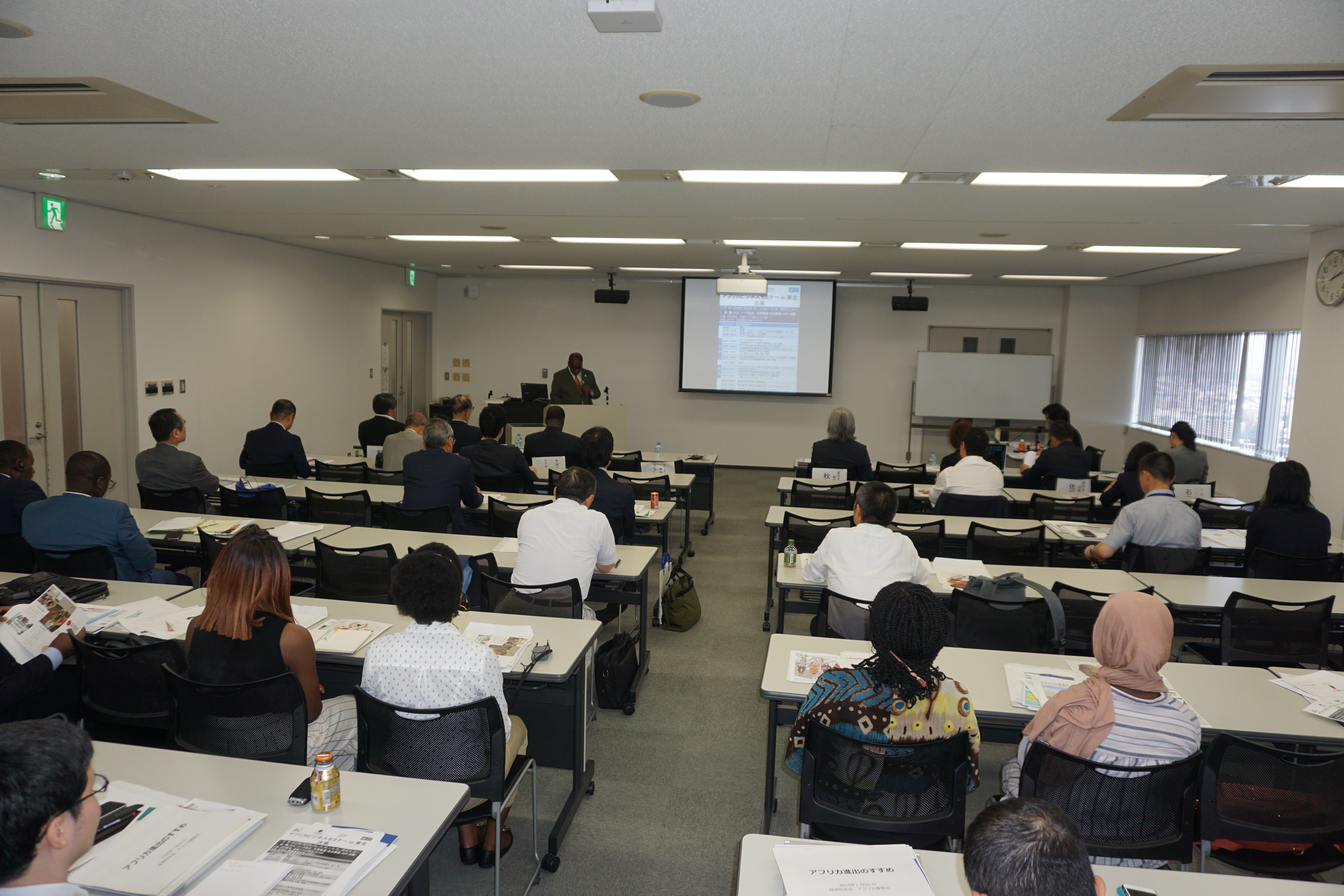
The Africa Business Seminar in Tohoku (ABST), held in Sendai on July 25, 2019, was a significant milestone in AFAM’s efforts to deepen practical Africa–Japan engagement at the regional level. Co-organized by the African Association of Miyagi (AFAM) and the Japan International Cooperation Agency (JICA), and co-sponsored by the Japan External Trade Organization (JETRO), the United Nations Development Programme (UNDP), and the Japan Association of Corporate Executives, the seminar was designed as a high-impact platform for dialogue, partnership, and opportunity.
The seminar pursued two central objectives. First, it sought to expose the Japanese investment community to the vast and evolving opportunities across the African continent. Second, it aimed to connect African students in Japan with Japanese institutions and businesses for internships, professional exposure, and possible job placement, thereby helping them gain experience in Japanese business culture and workplace systems.
AFAM’s Strategic Initiative
This seminar reflected AFAM’s broader vision of serving as a bridge between Africa and Japan—not only culturally, but also economically, intellectually, and professionally. By convening government officials, business leaders, academics, development practitioners, and African students on one platform, AFAM demonstrated its unique ability to create meaningful spaces where dialogue can lead to action.
ABST was one of several important pre-events organized ahead of the Seventh Tokyo International Conference on African Development (TICAD7), which was scheduled to take place in Yokohama from August 28 to 30, 2019. The event attracted 40 participants, including 14 representatives from companies, underscoring the growing interest in structured Africa-focused engagement in the Tohoku region.
Opening Perspectives
The seminar began promptly at 2:00 p.m. with opening remarks by Mr. Noguchi Shuji, Senior Regional Coordinator of the Second Africa Division of the Japanese Ministry of Foreign Affairs. He provided a concise historical overview of Africa–Japan cooperation and highlighted the evolution of this relationship through the TICAD framework.
His remarks set the tone for a forward-looking dialogue focused not merely on development cooperation in the traditional sense, but on partnership, investment, knowledge exchange, and mutual benefit.
Africa’s Investment Potential
H.E. Mr. Frank Okyere, Ambassador of the Republic of Ghana to Japan, followed with a compelling presentation on Africa’s investment potential. He encouraged Japanese businesses and entrepreneurs to take advantage of the opportunities being created across the continent through both African government reforms and expanding Japan–Africa cooperation frameworks.
He emphasized that regional integration mechanisms such as the ECOWAS Trade Liberalisation Scheme (ECOWAS TLS) and the African Continental Free Trade Area (AfCFTA) were laying the groundwork for broader and more efficient business operations across all 54 African countries. His remarks reinforced the message that Africa should be viewed not as a fragmented landscape of risk, but as an increasingly connected arena of opportunity.
Business Analysis and Corporate Engagement
Mr. Ishizuka Tatsuro, Vice-Chairman of the African Committee for Economic Coordination at the Japan Association of Corporate Executives, advanced the discussion by presenting a concise SWOT analysis of doing business in Africa. He observed that one of Africa’s greatest strengths lies in its youthful and growing population, whose energy and potential represent an important asset for future business collaboration.
Ms. Tomomi Ishida, Private Consultant at the UNDP Japan Representative Office on TICAD, then spoke on corporate support for small and medium-sized businesses in Africa. She highlighted the alignment between business opportunity and the Sustainable Development Goals (SDGs), particularly in sectors where innovation can improve livelihoods, such as clean water access, sanitation, and waste management.
JICA, Students, and Professional Pathways
Mr. Katsuyoshi Sudo, First Director of the JICA Tohoku Center, explained JICA’s collaboration with the private sector and its support for international students. He referred to the African Business Education (ABE) Initiative for Youth, which has exposed many African students to Japanese academic and corporate environments before they return home with knowledge and experience to strengthen African business ecosystems.
Importantly, he encouraged Japanese companies present at the seminar to engage the JICA office if they were interested in hosting African interns. This point directly aligned with AFAM’s concern that African students in Japan should have more structured access to workplace opportunities and practical experience.
Case Studies and Academic Perspectives
Mr. Shunsuke Sato presented the success story of Kanedai Namibia Fishing Services, headquartered in Kesennuma City, Miyagi Prefecture, as a concrete case of Japanese corporate presence in Africa. His presentation gave participants a practical example of how business cooperation between Japan and Africa can take shape beyond theory.
After a short break, Professor Akita Jiro of the Graduate School of Economics at Tohoku University spoke on the engagement of international students in Japanese workplaces during and after their studies. He introduced the DATEntre Programme, an initiative designed to make job searching in Japan easier and more structured for international students.
The Voice of African Alumni and Young Professionals
Adding a valuable personal dimension to the seminar, Ms. Imane Bouamama, an alumna of the ABE Initiative from Morocco and a member of AFAM who now works with Armonicos Co. Ltd. in Tokyo, shared her experience of transitioning from student life into the Japanese workplace.
She spoke about the publication of a magazine called “African Mags,” developed by ABE Initiative alumni to tell stories that help bridge understanding between Japanese society and Africa. She also shared her aspirations to lead future business expansion through Armonicos Morocco, demonstrating how African professionals in Japan can become active agents of bilateral connection and innovation.
The Africa Business Seminar in Tohoku showed that AFAM is not only a cultural platform, but also a strategic convener capable of linking ideas, people, institutions, and opportunities across Africa and Japan.
AFAM’s Leadership and Closing Reflection
The seminar closed with remarks by Dr. Isaac Yaw Asiedu, President of AFAM, followed by a networking session for all participants. The event concluded at approximately 4:45 p.m., but its significance extended far beyond the day itself.
ABST demonstrated AFAM’s capacity to initiate and lead conversations that matter—conversations that connect African students to opportunity, bring Japanese businesses closer to African realities, and create platforms for long-term collaboration rooted in mutual respect and shared interest.
Conclusion
The Africa Business Seminar in Tohoku was a timely and forward-looking initiative that highlighted AFAM’s strategic importance in the growing relationship between Africa and Japan. It created a space where investment, education, development, and employment could be discussed not in isolation, but as interconnected elements of a broader partnership.
Through this initiative, AFAM affirmed its role as an organization capable of translating vision into convening power, and convening power into practical pathways for Africa–Japan engagement. The seminar remains a strong example of AFAM’s commitment to empowering African students, informing Japanese stakeholders, and building lasting bridges between two regions with immense potential for collaboration.