
By Dr. Isaac Yaw ASIEDU
President, African Association of Miyagi (AFAM)
Introduction: A Misdiagnosed Problem
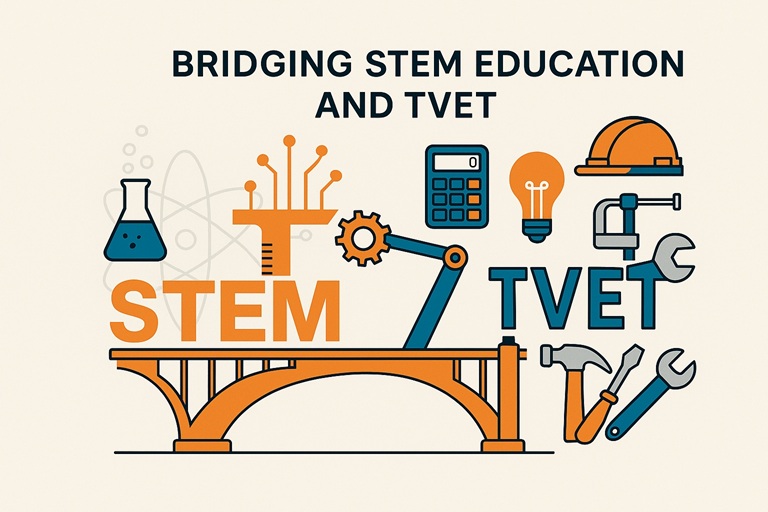
A familiar refrain in discussions on African development is that Africans are “not creative” or “less innovative” compared to other regions. While provocative, this claim is deeply misleading. It misdiagnoses the problem as a matter of intellectual deficiency, when in fact it is a systemic failure of education and industry linkages. Africa’s creativity is not absent; it is constrained by the lack of bridges between Science, Technology, Engineering and Mathematics (STEM) education and Technical and Vocational Education and Training (TVET).
STEM provides theory, critical thinking, and problem-solving frameworks. TVET emphasizes hands-on application, practical skills, and workforce readiness. When kept apart, each becomes incomplete: STEM risks irrelevance, and TVET risks stagnation. But when fused, they generate innovation, entrepreneurship, and technological progress. Creativity flourishes when conceptual knowledge finds expression in practical work, and when practical skills are sharpened by scientific understanding.
The Problem of Parallel Tracks
In many African classrooms, students excel at solving textbook equations in physics, chemistry, or mathematics. They can, for instance, recite Newton’s Second Law — that force equals mass multiplied by acceleration — with accuracy. Yet, too often, this knowledge remains trapped on paper, disconnected from the machines, systems, and industries that would give it life.
On the other side, TVET students may learn to service engines, weld metals, or install electrical wiring, but without a strong grasp of the underlying principles. Their skills are valuable, but they remain bounded by routine tasks. Innovation requires more than repetition; it requires the ability to combine science with practice to generate new solutions.
This artificial separation suffocates creativity. Students emerge either with knowledge that cannot be applied, or skills without the theoretical depth to evolve into innovation. The result is a workforce that is competent but rarely transformative — capable of “doing,” but less capable of “creating.”
Newton’s Second Law as a Case Study
Consider Newton’s Second Law of Motion, F = m·a.
- In a STEM-only model, it remains an equation solved in examinations. Students can calculate the force required to accelerate a mass, but their engagement ends with pen and paper.
- In a TVET-only model, learners may be trained to replace brake pads or tighten bolts without understanding the physics that governs braking dynamics.
- In a bridged model, however, students calculate the braking force required to stop a car, translate it into torque at the wheel, and select suitable calipers from a manufacturer’s catalog. They then test their design in a workshop, measuring results and adjusting for safety margins.
This third scenario is where creativity resides. A law of motion is no longer abstract — it becomes a tool for engineering real-world solutions. Such integration transforms learners into innovators capable of designing, prototyping, and refining technology.
Lessons from Ghana’s Experience
Ghana offers a compelling case of the STEM–TVET paradox. At EXPO 2025 Osaka Kansai, Japan, Ghana’s Theme Weeks featured the program “Advancing STEM, TVET, and Remote Learning to Achieve SDG 4 in Ghana”. The event, broadcast live on YouTube, highlighted a striking contradiction: many Ghanaian TVET institutions are now equipped with modern laboratories and facilities that surpass those available in local industries.
This irony reveals a structural bottleneck. Students train on advanced simulators, CNC machines, and digital systems in their schools, but when they enter the workforce, companies lack equivalent infrastructure to absorb and challenge them. As a result, knowledge and skills stagnate at the point of transition. Without modernized industries, large-scale practical application becomes impossible.
This gap illustrates why bridging STEM and TVET must not stop at curriculum reforms within schools. The bridge must extend outward into industries. Investment, modernization, and sustained collaboration between schools and companies are critical. Otherwise, Africa risks producing graduates who are more advanced than the industries they enter, leaving their potential unrealized.
Why the Myth of “Uncreativity” Persists
The false narrative that Africans are uncreative is sustained by four interlinked systemic issues:
- Over-Theorization – Classrooms emphasize memorization and examinations rather than applied problem-solving.
- Stigma Against TVET – Vocational training is perceived as inferior to academic tracks, deterring talented students from pursuing it.
- Industrial Backwardness – Many African companies lack the tools and technologies to partner effectively with TVET institutions.
- Policy Disconnect – STEM and TVET remain siloed in planning and funding, with little integration across ministries or sectors.
These structural weaknesses create the illusion of a continent short on creativity, when in reality it is short on bridges.
Reclaiming Creativity: A Five-Point Agenda
- Curriculum Redesign
- Infuse TVET curricula with essential STEM principles such as mechanics, electronics, and coding.
- Transform STEM classes by embedding applied projects, prototyping, and design challenges that compel learners to test theory in practice.
- Strengthen Industry–School Partnerships
- Provide tax incentives for companies that modernize equipment and host apprenticeships.
- Establish joint training centers co-managed by industries and TVET institutions to align training with evolving technologies.
- Encourage companies to co-design curricula, ensuring alignment with workplace realities.
- Innovation Hubs and Makerspaces
- Create low-cost innovation hubs in every TVET institution, providing tools for students to prototype and experiment.
- Link these hubs with national competitions, incubators, and entrepreneurship funds to transform student projects into viable enterprises.
- Foster cross-pollination by connecting university researchers with TVET learners in shared innovation labs.
- Changing Perceptions of TVET
- Launch national campaigns portraying TVET as a first-choice pathway to entrepreneurship and innovation.
- Publicize success stories of inventors, engineers, and entrepreneurs who emerged from vocational training.
- Incentivize media houses to showcase innovations from TVET graduates.
- Policy Integration and Regional Alignment
- Create an inter-ministerial task force linking Education, Trade, and Industry to harmonize STEM–TVET reforms.
- Align Ghana’s reforms with African Union (AU) and ECOWAS frameworks to ensure continental competitiveness.
- Develop national monitoring systems to track the impact of integration on job creation and innovation indices.
Broader Impacts and Expected Outcomes
If Ghana and Africa embrace this agenda, several benefits will follow:
- A creative and job-ready workforce, equipped with both conceptual understanding and practical competence.
- Greater industrial innovation, as student projects feed directly into product design, manufacturing, and service improvement.
- Reduction in the stigma surrounding vocational training, broadening participation and improving labor market equity.
- Strengthened national and continental competitiveness, as Africa generates not just workers, but innovators who can compete globally.
Conclusion: Creativity Through Connection
Creativity is not an inborn privilege of certain regions. It is the outcome of systems that enable learners to connect knowledge with practice. Africa has the intellectual talent, youthful energy, and cultural drive to innovate. What is missing is the deliberate fusion of STEM and TVET, supported by industries capable of sustaining that integration.
When Newton’s Second Law is no longer confined to the classroom but is engineered into brake systems, conveyor belts, or renewable energy devices, the so-called “creativity gap” disappears. Africa’s challenge is not a lack of brains, but a lack of bridges. The task before policymakers, educators, and industry leaders is clear: build the bridge, and creativity will flow.